Gaddr Jobs — From scattered tools to a unified workflow: Building the Gaddr Ecosystem.

01.Gaddr Jobs — Foundational Role
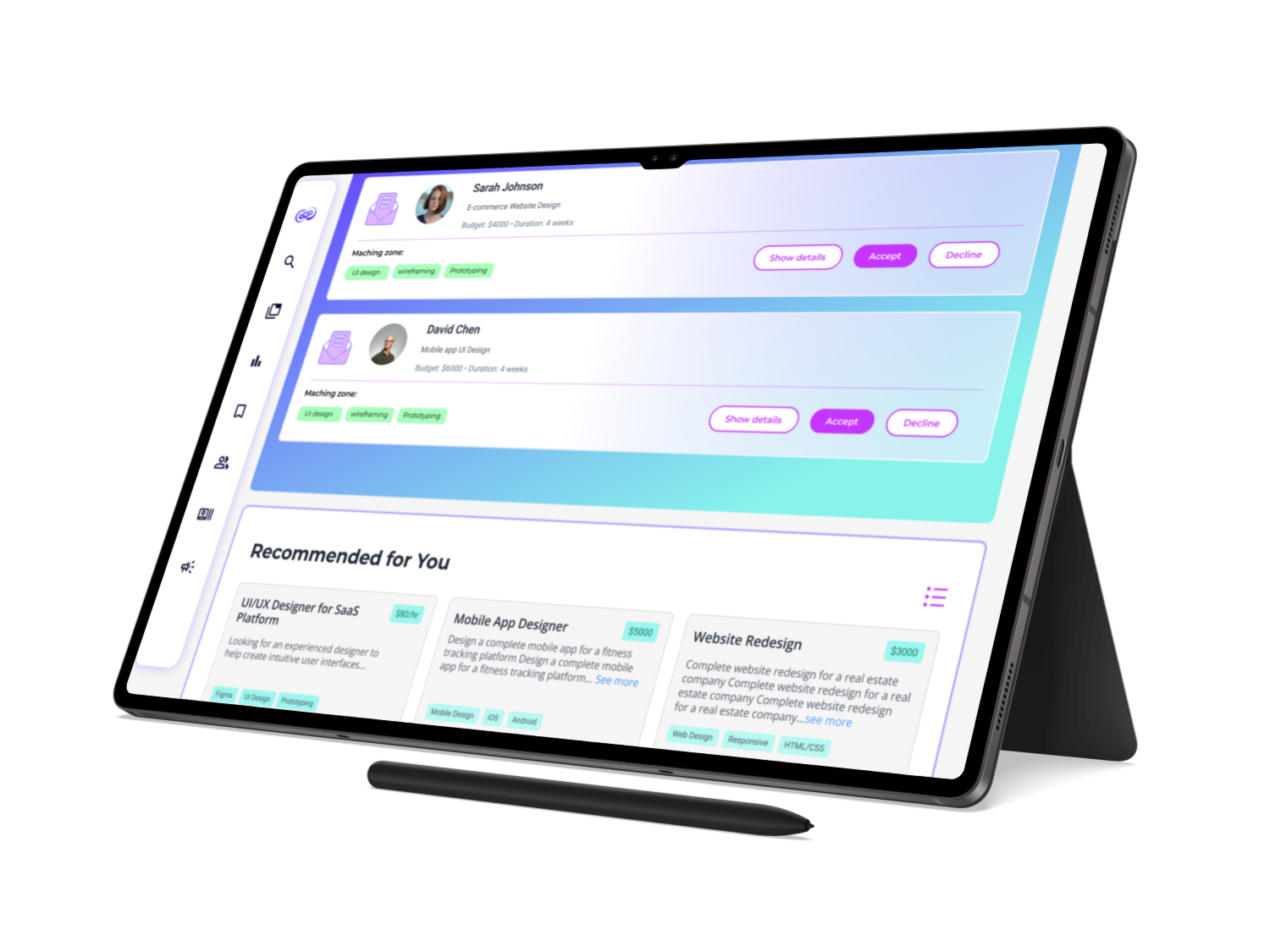
Gaddr Jobs was the next step in the Gaddr ecosystem — a new product meant to connect recruiters, freelancers, and job seekers.
When I joined, the concept existed, but not the users.
We knew we wanted to build “a jobs platform”, but we didn’t yet truly understand who we were designing for, how their needs differed, or how their journeys would connect. Together with other designers, I helped define the first user personas, map their journeys, and draft the initial flows that would become the MVP.
As that work progressed, a different problem appeared: our design process itself was breaking. That’s when my role shifted into a Lead Designer position with a foundational mission — to make the team able to deliver.
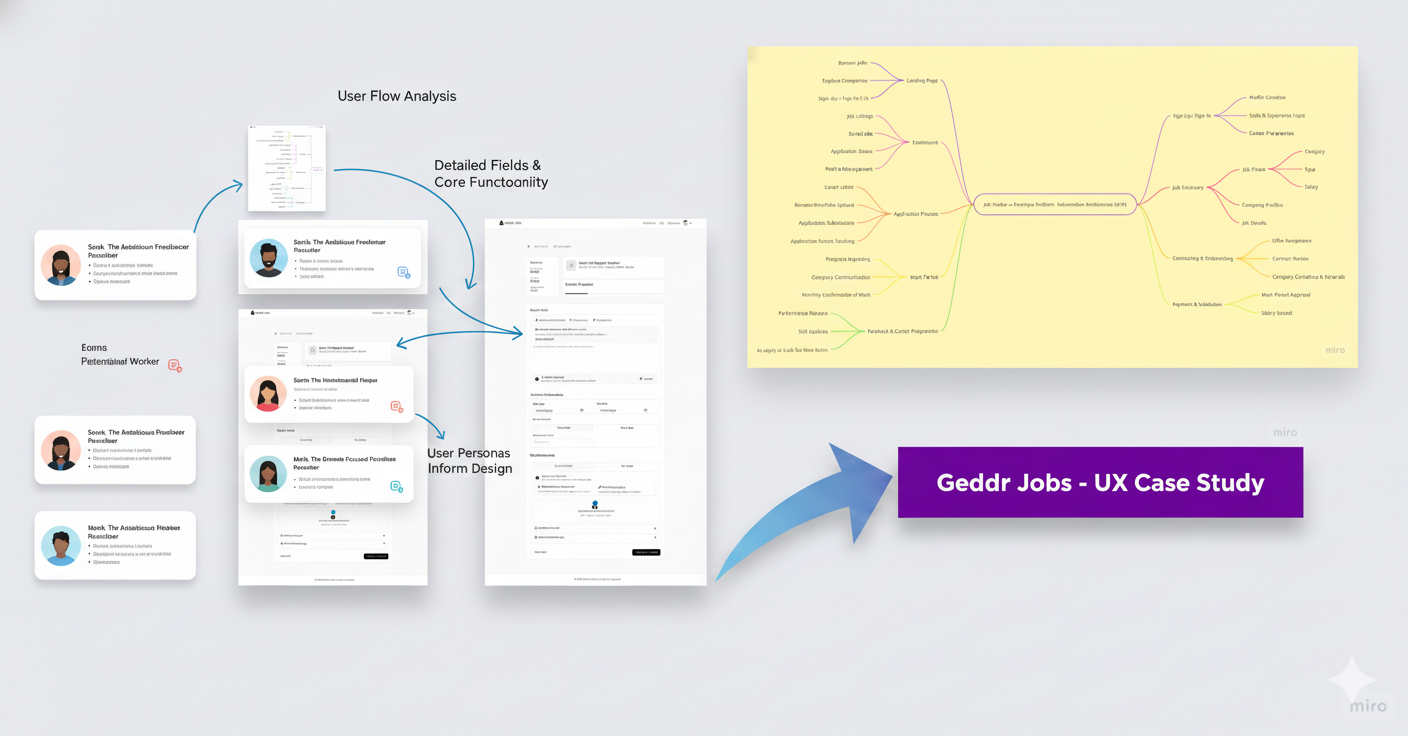
Early persona and flow definitions were created with the design team before establishing the workflow foundation.
02.The Challenge - Scaling culture before scaling the product.
The biggest challenge wasn't just defining the user experience for Gaddr Jobs, but structuring the team that would build it.
I took over a group of talented interns who lacked a unified methodology. Design was happening in isolation, communication with stakeholders was broken, and our Figma files were unstructured—making developer handoff a nightmare. To make matters worse, new interns were joining the team every week.
My primary goal was to professionalise the department: establishing clear communication channels, standardising our files, and creating a cohesive Design Ops system so creativity could finally thrive within a structured framework.
We were tasked with designing an MVP in this environment. But first, we needed to design how we would work.
That became my core responsibility as Lead Designer: building a framework that made collaboration possible—clean, traceable, and scalable.
03. What I Did as Lead Designer
I didn’t just design screens — I designed how we worked.
1. Creating a shared workflow
I defined how we built wireframes and how those evolved into UI.
Each designer had a clear frame structure, annotation style, and naming pattern.
This meant multiple people could work on the same flow without breaking consistency.
2. Clarifying ownership and coordination
I mapped all design tasks, assigned them to the right people, and coordinated with the rest of the team to avoid overlaps.
Every designer knew exactly what to focus on, and when.
Coordination stopped depending on endless Slack threads.
3. Documenting everything
I created the first design documentation for Gaddr:
how to name components, how to organize pages in Figma, how to reference user flows, and how to communicate updates.
It became the onboarding base for every new designer joining the team.
4. Introducing visual foundations
We started our first version of tokenization — color, typography, spacing, states.
Nothing fancy, but enough to bring visual order across files.
From that point, buttons, inputs, and dropdowns behaved the same way everywhere.
5. Streamlining handoff
I worked with the CEO and Project Manager to decide what was truly essential for the MVP and to prepare clean handoff files for developers.
The design team stopped handing over drafts and started handing over decisions.
By the time this framework was in place, design stopped being a set of isolated efforts.
It became a system — one the team could actually build upon.
Interlude — Understanding the Gaddr Ecosystem
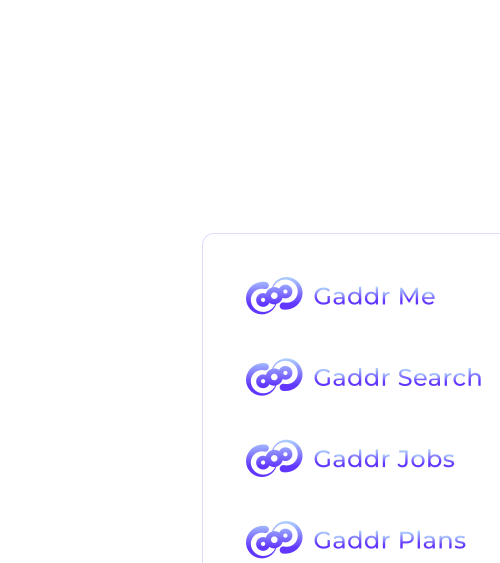
Gaddr is more than a job platform.
It’s a connected ecosystem designed to simplify digital life — linking identity, content, work, and discovery through intelligent, AI-powered products.
The suite includes:
Gaddr Me — A universal profile that brings together your online identity and content.
Gaddr Search — A unified search engine for trends and social media insights.
Gaddr Jobs — The vertical focused on connecting people and opportunities: recruiters, freelancers, and job seekers.
Gaddr Plans — A productivity hub for managing projects, teams, and tasks.
All products share one goal: to reduce fragmentation and give users control over their digital world.
Our challenge was to design Gaddr Jobs as a coherent part of that ecosystem — aligned in logic, visual language, and user experience.
04. Designing Gaddr Jobs
Once the foundation for collaboration and design consistency was in place, we turned our attention to building the product itself — Gaddr Jobs, the vertical connecting recruiters, freelancers, and job seekers within the Gaddr ecosystem.
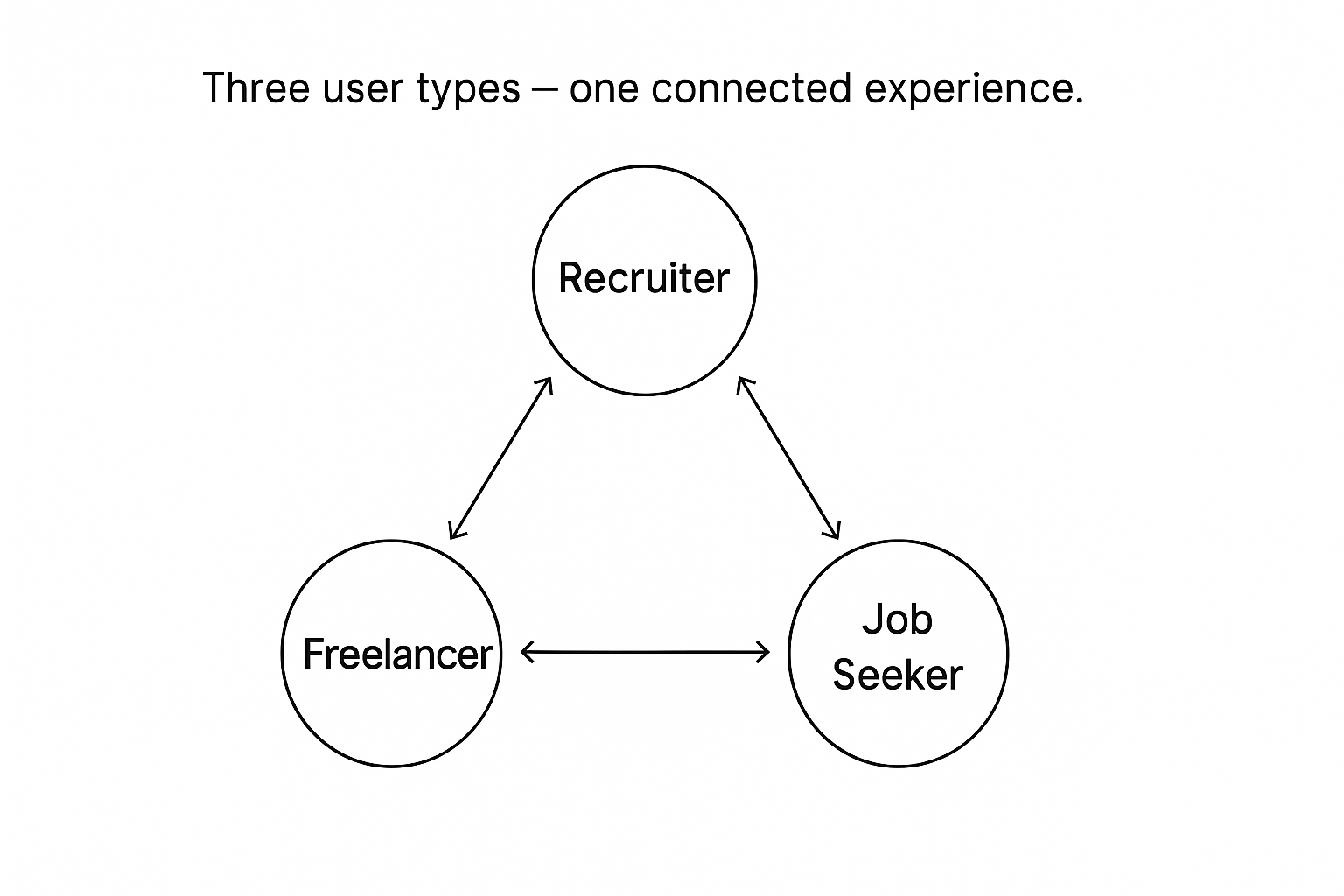
Our task was to define the three core user types and create the flows that would make interaction between them seamless and traceable:
Recruiters needed a clear way to post jobs, review candidates, and manage interviews.
Freelancers require transparency when applying, negotiating milestones, and tracking project progress.
Job Seekers wanted a straightforward way to apply for roles and follow their application status.
We worked on the MVP in iterative sprints, defining essential features for each role and ensuring every flow was part of one connected system.
While the UI was a large part of the work, the main challenge was logic:
How to make one action —a recruiter’s post, a freelancer’s proposal, a job seeker’s application— trigger a visible, meaningful update for the other two roles.
This required designing interdependent journeys, each with its own interface but governed by the same design principles and interaction rules.
05. The Recruiter Flow (Evolution & MVP)
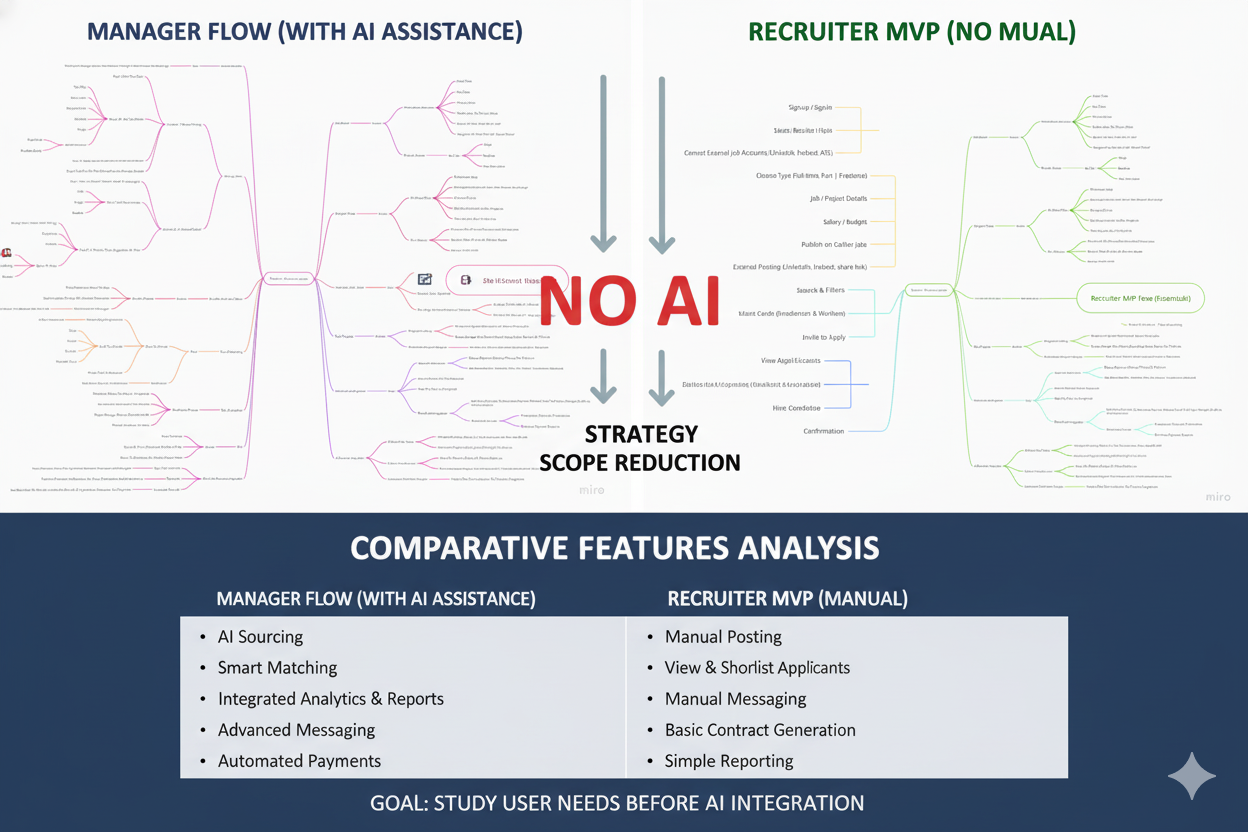
The first version of the flow was conceived under Gaddr Management (now Plans), where the “Manager” role included complex outsourcing features powered by AI and blockchain.
The goal was to automate talent matching, payment, and contract management inside one intelligent system.
However, as the project evolved, we realised that we needed to simplify — to truly understand the user before expanding the technology. In that way, we could test and get insights on what the user really needed and how we could implement the use of AI inside our system.
I led the transition from the AI-powered Manager Flow to the Recruiter MVP Flow, redefining how the role operated within Gaddr Jobs.
The new MVP removed internal payments and automation, focusing on clarity, usability, and consistency across the Gaddr ecosystem.
We aligned the login and onboarding with Gaddr’s universal authentication, so users could move seamlessly between products (Me, Plans, Jobs) under a single account.
Recruiters could:
- create or log in with their Gaddr universal account,
- post new roles or projects,
- discover and shortlist talent from the shared pool,
- invite candidates or freelancers,
- manage interviews and onboarding, and close a contract.
The system allowed recruiters to save favourites, visit user profiles, and track their interactions directly from the dashboard — bringing structure to what had been a fragmented process.
This version became the foundation for all following research:
How and where to reintroduce AI to add value to recruiters without removing their control.
06. Setting the Ground for AI Research
After stabilising the MVP and defining the recruiter experience, our next step was to explore how artificial intelligence could add value without creating dependency.
Instead of rushing to implement features, I proposed a structured research phase to understand what kind of assistance recruiters actually wanted.
As Lead Designer, I created a research framework that outlined:
- Goals: what we needed to learn before adding AI-driven features.
- Tasks: concrete steps for discovery, interviews, and competitive analysis.
- Documentation standards: how findings would be recorded and shared across design and dev teams.
- Evaluation criteria: measurable impact on user experience, not just technical feasibility.
This process transformed our approach: AI was no longer “a feature to add”, but a layer of support — a way to reduce friction, speed up decisions, and make recruiters feel more empowered.
The outcome was a set of early hypotheses for the Beta Plus phase:
- AI suggestions for candidate matching.
- Predictive insights on project timing and workload.
- Smart prompts during posting or reviewing tasks.
By that point, Gaddr Jobs wasn’t just a product — it was becoming a system that could learn from how people work.
07. The Recruiter Journey
Recruiters on Gaddr Jobs didn’t need more tools — they needed a clearer path.
Our goal was to turn the hiring process into one continuous experience, connected to the rest of the Gaddr ecosystem.
The journey was built around five key moments:
- Sign in & Identity — One login across all Gaddr products, creating a consistent start for every user.
- Create a Job Post — A guided form with structured fields and previews, focused on clarity and speed.
- Discover & Invite — Search, filters, and favourite lists inside a single workspace.
- Manage Interviews — Centralised scheduling and feedback in one view.
- Hire & Close — A clean, conclusive flow that completes the recruitment cycle without detours.
What We Learned
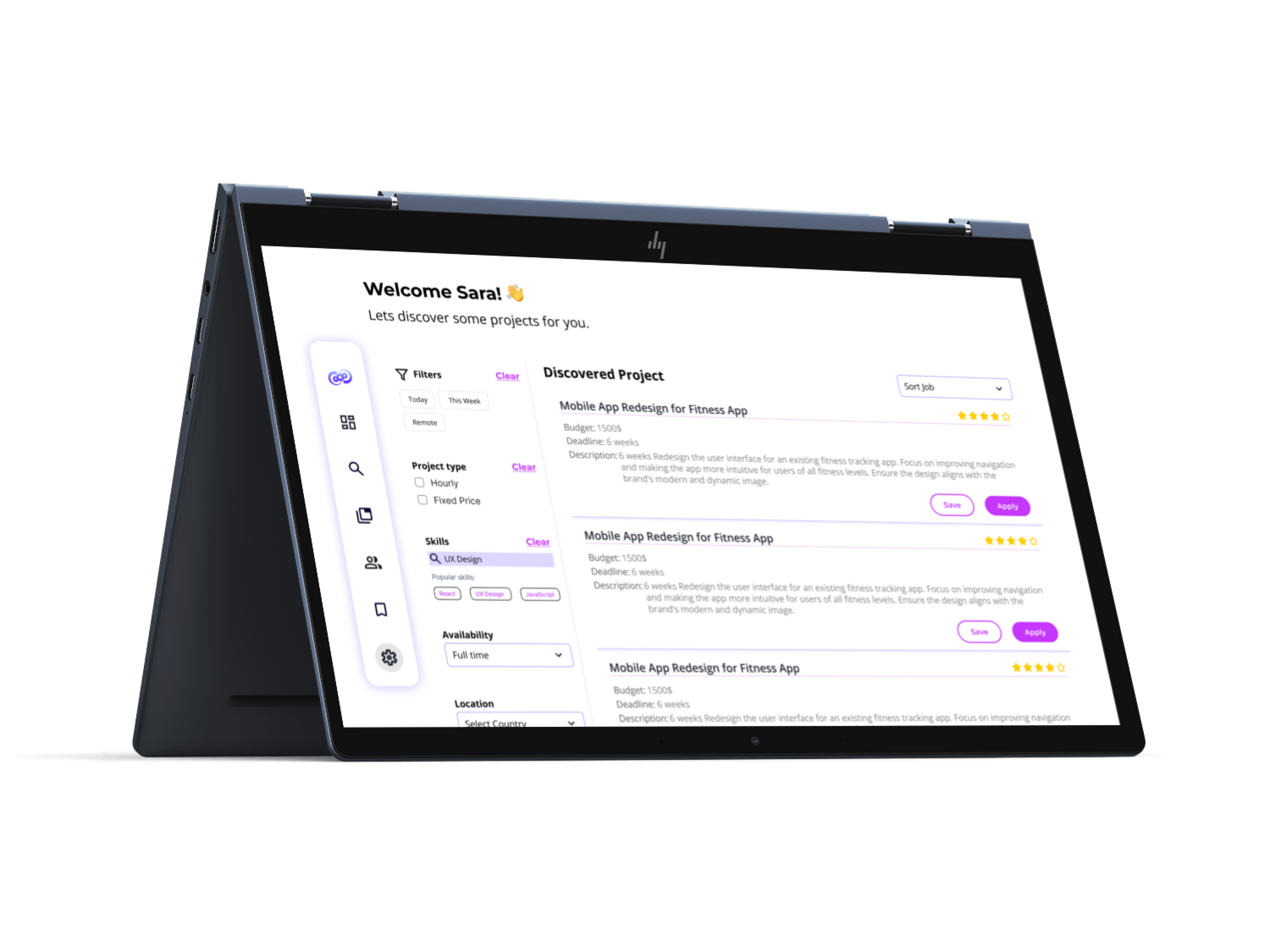
During testing, recruiters, freelancers, and job seekers all pointed to the same pain point — the filters.
They criticised the standard used by large platforms like LinkedIn: too many options, poor results, and no sense of priority.
Our surveys confirmed it:
- The filters didn’t return accurate matches.
- The order of options mattered more than we thought.
- Categories felt unclear and uneven across user types.
We redesigned the system to make it simpler and coherent:
- Improved categories and their order based on real user search behaviour.
- Introduced sliders for range-based values (such as rates or availability).
- Unified the UI across all user types while respecting each one’s specific needs.
The result was a set of filters that finally behaved as users expected — clear, fast, and aligned with how they actually look for work or talent.
This phase taught us that even a small interface element can be the difference between a tool that feels smart and one that feels broken.
Designing this flow taught me that sometimes the most powerful improvements aren’t about adding intelligence, but removing confusion.
08. Reflection
Designing Gaddr Jobs wasn’t just about building a new product — it was about learning how structure and clarity can hold a team together.
As Lead Designer, a new experience for me, I discovered that foundations aren’t made of components or screens, but of shared understanding.
Creating alignment between designers, product managers, and developers became the real design work.
What stayed with me most was how the smallest parts — filters, naming, task flow order — shaped the entire experience.
When those elements finally worked, the product felt honest.
This project reminded me that design isn’t about chasing technology — it’s about earning its place.
Before adding what’s new or intelligent, the user has to be able to complete their action without friction, without doubt.
Only then can technology make their life better instead of more complicated.
Sometimes good design just clears the way, so the tool can do what it’s meant to do — quietly, and well.
“Clear flows before clever tools.”
Let the user finish what they came to do — then make it smarter.
Selected Works